
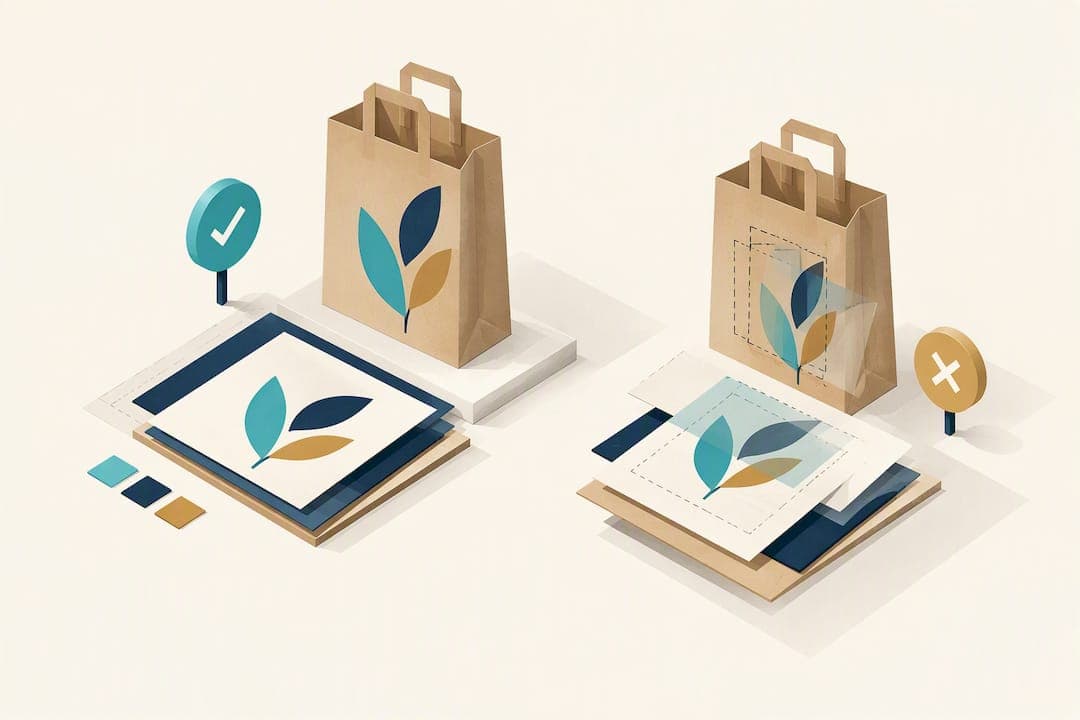
For most retailers and hospitality brands, the safest route to reliable branded paper bags is a consultative specialist supplier who runs a technical print audit before production starts. That step catches substrate and ink problems early, protects recyclability and cuts the risk of a reprint. The rest of this guide walks through materials, print methods, costs, artwork and how to order with confidence.
TL;DR:
- Digital printing suits orders under a few thousand units and complex colors; flexo or litho lowers unit costs for recurring, higher volume runs.
- Send vector logos in CMYK, use the supplier’s dieline, keep key artwork inside safe zones, and request a kraft proof when exact colors matter.
- For mixed retail and hot food, separate bag formats can cost less than coating every bag; oily foods need a barrier against grease.
- Keep plastic below 5% of pack weight where possible, avoid permanent windows and heavy metallization, and qualify recyclability claims when barriers remain.
- In England, the mandatory 10 pence charge applies to plastic carrier bags sold for single use, not paper bags; retailers may choose whether to charge.
Table of Contents
- Why choose a specialist supplier and what a good outcome looks like
- Paper bag styles, materials and finishes: choosing by use case
- Print methods explained and when to use each
- Typical costs, minimum order quantities and lead times
- Artwork, technical files and pre-press checklist
- Sustainability and recyclability: what to spec for circularity
- Ordering process and supplier questions to ask
- A practitioner's view on what actually moves the needle
- How Niche Pack helps with paper bag branding
- FAQ
- Sources
Why choose a specialist supplier and what a good outcome looks like
A technical print audit sounds like jargon, but it is simply a check that your artwork, chosen substrate and print method will actually work together before a single bag rolls off the press. Skipping it is the single biggest cause of failed runs: packaging design should be treated as a technical process first, with product physics and format confirmed before artwork is finalised. Suppliers who build this check into their process catch problems with grease resistance, handle strength or colour reproduction before you have committed to thousands of units.
Working with a supplier who takes this material-first approach tends to produce a few consistent outcomes:
- Print quality that matches your proof, run after run, because the substrate and inks were matched up front.
- Fewer reprints and less wasted stock, since problems get caught at the audit stage rather than the delivery stage.
- A bag that actually reads as "your brand" rather than a generic kraft sack with a logo stuck on top.
Before you commit to a supplier, it is worth understanding the commitments most reputable printers will ask you to accept. Minimum order quantities vary by format and print method, proofing is nearly always required before full production, and lead times depend on how busy the press schedule is. A supplier who is upfront about all three, rather than glossing over them in a sales call, is usually the one worth trusting with your brand.
Paper bag styles, materials and finishes: choosing by use case
The right bag format depends on what you are putting inside it and how a customer will carry it. Carrier bags with twisted paper or flat die-cut handles suit retail purchases and gift-style transactions. Flat bags (no gusset) work well for flat items like greetings cards or thin baked goods. Gusseted bags, with that folded side panel, expand to hold bulkier takeaway orders, bakery boxes or multiple items stacked together.
Material choice matters just as much as format:
- Kraft paper is the most common base, strong, cost-effective and giving that recognisable natural look many hospitality brands want.
- White kraft offers a cleaner background for vibrant print colours, useful when your branding relies on bold or pastel tones rather than an earthy aesthetic.
- Recycled fibre papers suit brands leaning into an eco-conscious message, though they can show more visible fibre texture in print.
- Coated or laminated papers add grease and moisture resistance, important for hot food, but they need careful specification to avoid harming recyclability (more on that shortly).
Handles add another layer of decision-making: flat paper handles are cheaper and compact, twisted paper handles feel sturdier for heavier loads, and die-cut handles (cut straight into the bag body) keep costs down for lighter retail use. Finish options like spot UV, matt lamination or embossing can lift a design, but each adds cost and, in the case of laminates, needs checking against your recyclability goals.
For food contact use, grease resistance is non-negotiable if you are packing anything oily, like pastries, chips or pizza slices. A standard uncoated kraft bag will show grease spots within minutes; a grease-resistant coating or barrier keeps the bag presentable through the whole delivery or carry-home journey.

Pro Tip: If you sell a mix of dry retail goods and hot food, it is often cheaper to run two bag formats than to over-specify one bag with barrier coatings it does not always need.
Print methods explained and when to use each
The print method you choose affects both the look of your branding and what you pay per unit, so it is worth understanding the main options before requesting quotes.
Digital printing suits low to moderate run sizes and photographic or multi-colour designs with gradients. It needs no printing plates, so setup costs are low and short runs stay affordable, but the cost per unit stays relatively flat regardless of volume, which makes it less economical at scale.
Flexographic (flexo) printing uses flexible printing plates and is the workhorse for mid-to-large runs. It handles spot colours well (solid, flat brand colours printed precisely) and becomes significantly cheaper per unit as volume rises, though plate costs mean it suits fewer design changes across a run.
Litho (offset lithography) printing, more common for pre-printed paper reels later converted into bags, delivers sharp detail and consistent colour across very large runs, making it a fit for established brands ordering in bulk on a regular cycle.
Screen printing is less common for standard paper bags but turns up for specialty effects: metallic inks, textured finishes or extra-durable prints on heavier stock. It tends to cost more per unit and suits smaller, premium-feel runs rather than everyday takeaway volumes.
A few practical pointers when matching method to need:
- Choose digital if you are testing a new brand look or ordering under a few thousand units.
- Choose flexo or litho once you are ordering consistently at higher volumes and want the lowest unit cost.
- Reserve screen printing or special finishes for flagship product lines or limited editions where the extra spend pays for itself in shelf impact.
Typical costs, minimum order quantities and lead times
Several factors drive what you will pay for branded paper bags: bag size, substrate weight and type, number of print colours, any finishing (lamination, spot UV, handles) and, above all, order quantity. As a worked example, say a small café orders 1,000 kraft bags in a single spot colour: the unit cost sits towards the higher end of the typical range because setup costs are spread across a small run. Order 10,000 of the same bag and the unit cost drops meaningfully, since press setup and plate costs are shared across far more units. Order 50,000 and you typically reach the lowest achievable unit price, assuming the design and substrate stay unchanged.

Most quotes are structured around the same cost levers. Fewer print colours, a standard stock bag size and a single consistent design across the whole run are the three easiest ways to bring your quote down without compromising the finished look.
The typical order journey runs through four stages:
- Quote: you share your rough specification (size, material, quantity, print colours) and receive a cost estimate.
- Proof: a digital or physical sample is produced for your sign-off before full production begins.
- Production: the bulk run is printed, cut and finished according to the approved proof.
- Delivery: finished stock is packed and shipped, with timing depending on production load and courier schedules.
Turnaround from initial quote to delivery varies by supplier and season, so always confirm current lead times directly rather than assuming a fixed timeframe, particularly around busy periods when press capacity tightens.
Artwork, technical files and pre-press checklist
Supplying print-ready artwork correctly the first time avoids the most common cause of delay: a proof that comes back wrong and has to be reworked. A few technical basics make the difference.
- Submit vector logos, not flattened raster images, so your branding scales cleanly to the bag's print area without pixelation.
- Work in CMYK colour mode, since paper bag printing reproduces colour through CMYK inks, and any photographic elements should sit at 300 dpi minimum.
- Request the dieline from your supplier first, the flat template showing where folds, handles and seams sit, and build your design around it rather than guessing at proportions.
- Keep critical text and logos inside the safe zone, away from bleed edges and fold lines, so nothing gets trimmed or distorted during cutting.
- Account for substrate colour, since printing on natural kraft shifts every colour warmer than it would appear on white stock; ask your supplier for a kraft-specific colour proof if exact brand colours matter.
- Flag any varnish, metallic ink or overprint requirements early, as these need separate technical handling and can affect both cost and production timeline.
Pro Tip: Ask your supplier for a physical kraft swatch before finalising artwork colours. Screen colours and printed-on-kraft colours rarely match exactly, and a swatch check costs nothing compared to a reprint.
Before sending final files, run through a short checklist: vector logo confirmed, CMYK colour mode set, dieline used as the design template, bleed and safe zones respected, and any special finishes clearly noted in your file or order notes. This small discipline is what separates a smooth first proof from a frustrating back-and-forth.
Sustainability and recyclability: what to spec for circularity
Designing a paper bag that genuinely recycles well in standard UK paper mills comes down to a handful of specific choices, not a vague "go green" intention. CPI's 2024 recyclability guidance sets out design parameters so fibre-based packaging can be reprocessed in standard mills, and flags that coatings, laminates, plastic windows and wet-strength agents can all get in the way of that process.
Practical rules worth building into your spec from the start:
- Favour peelable laminates over permanently bonded plastic films, so the barrier layer can be separated during repulping.
- Avoid permanent plastic windows and heavy metallisation, both of which are harder for standard mills to process.
- Keep total plastic content under 5% of pack weight where possible, which aligns with the recyclability parameters the industry prefers and avoids disrupting the recycling stream.
- If a grease or moisture barrier is unavoidable, specify it as a removable or low-impact option rather than a fully sealed laminate.
On the regulatory side, it helps to know where paper bags sit relative to plastic. Gov that retailers in England must charge a minimum of 10 pence for single-use plastic carrier bags, but paper bags are not subject to that mandatory charge, which is one reason many hospitality brands have shifted toward paper as their default carrier. Separately, waste handling obligations are tightening: the Simpler Recycling guidance from WRAP requires businesses to arrange separate collections for core recyclables, with transitional arrangements for micro-businesses lasting until 31 March 2027. If you run a small café or takeaway, that transition window is worth noting when you plan your own waste contracts.
When you communicate recyclability to customers, keep the message accurate rather than aspirational: say what the bag is made from, note whether it carries a barrier coating, and avoid blanket "100% recyclable" claims if your design includes any laminate or metallic element that standard mills cannot process.
Ordering process and supplier questions to ask
Choosing a supplier is easier when you work through the same set of questions every time, rather than relying on how polished a sales pitch sounds.
- Ask what material options are available and whether any of them carry a grease-resistant or moisture barrier suited to your product.
- Confirm food-safety compliance for any bag that will hold food directly, particularly where oils or sauces are involved.
- Check minimum order quantities against your actual order frequency, since a low MOQ matters more for a small café than a large chain ordering consistently.
- Ask about the proofing process, specifically whether you will see a physical or digital proof before full production and how many rounds of changes are included.
- Confirm lead times in writing, including what happens if your order falls during a busy production period.
- Request a technical print audit before committing to a large run, so your artwork, substrate and print method are checked for compatibility before costs are locked in.
Once bags arrive, a quick quality check pays for itself: compare colour against your approved proof under good light, check handle strength on a sample bag, and confirm the print has not smudged or cracked along fold lines. If anything falls short, raise it immediately and ask for corrective action or a re-sample rather than accepting a run that does not match what you approved.
A practitioner's view on what actually moves the needle
Having worked through packaging projects across independent hospitality brands, the pattern that stands out most is simple: the brands that get a bag right first time are the ones who settle the material and technical questions before they touch final artwork, not after. One project for an independent dessert brand, Chutney Ivy, illustrates the point well. The priority wasn't a flashier design, it was confirming grease resistance, handle strength and print compatibility before the logo colours were even locked, which meant the final run matched the proof exactly and avoided a costly reprint.
The lesson generalises beyond that one project. Conventional wisdom treats packaging design as a creative exercise with technical details filled in afterward. In practice, the reverse order works better: lock the physics first, then let the design live comfortably inside those constraints.
— Melanie
How Niche Pack helps with paper bag branding
We built our process around addressing the common issue many independent hospitality brands face: generic, unbranded bags that do nothing for the identity you have spent years building. Working with us, you get design-to-delivery consultation, production for agile turnaround, and technical print audits built into the process so your artwork and substrate are checked before full production, not after.

What we offer alongside bags:
- Expert consultation that helps translate your brand into a workable packaging spec, even if you have no design background.
- Accessible minimum order quantities suited to independent restaurants, cafés and dessert businesses.
- Sustainable material options for brands who want their packaging to reflect genuine environmental care.
If paper bags are part of a wider packaging refresh, our range redevelopment and strategic production services cover cups, bowls, boxes and sleeves alongside bags. Browse our custom packaging shop to see current product lines and start a quote.
FAQ
Where can I get personalised paper bags printed?
Specialist packaging suppliers who offer design consultation and technical print audits are generally the most reliable route, since they catch substrate and artwork issues before production rather than after delivery. Direct suppliers who work specifically with hospitality and retail brands tend to understand food-contact requirements better than generic print shops.
Is paper bag making a good business?
Paper bag manufacturing can be viable given steady demand from retail and hospitality sectors, particularly as paper bags remain outside the mandatory plastic bag charge that applies in England. Success in the sector depends heavily on production efficiency, material sourcing and the ability to meet recyclability expectations that CPI guidance sets out for UK mills.
Is it a legal requirement to charge for paper bags?
No, GOV.UK guidance confirms that the mandatory minimum 10 pence charge in England applies specifically to single-use plastic carrier bags, not paper bags. Retailers can choose whether to charge for paper bags as part of their own packaging strategy.
How do I print my logo on bags?
Supply your logo as a vector file in CMYK colour mode, along with your supplier's dieline template, so your branding scales correctly and sits within the safe print area. Your supplier will typically produce a proof for approval before running the full order, which is the stage to confirm colour accuracy against your brand guidelines.
What should I check before choosing a paper bag supplier?
Confirm material options, food-safety suitability, minimum order quantities and proofing policy before committing to an order. Asking whether a supplier runs a technical print audit before production is one of the clearest signs of a process built to avoid reprints.
Sources
- Gov
- Helping retailers and brands specify and design fibre-based packaging that can be reprocessed in standard paper mills in the UK (CPI, 2024)
- Effective packaging requires two types of designers
- Simpler Recycling guidance for public service providers (WRAP, 2026)