
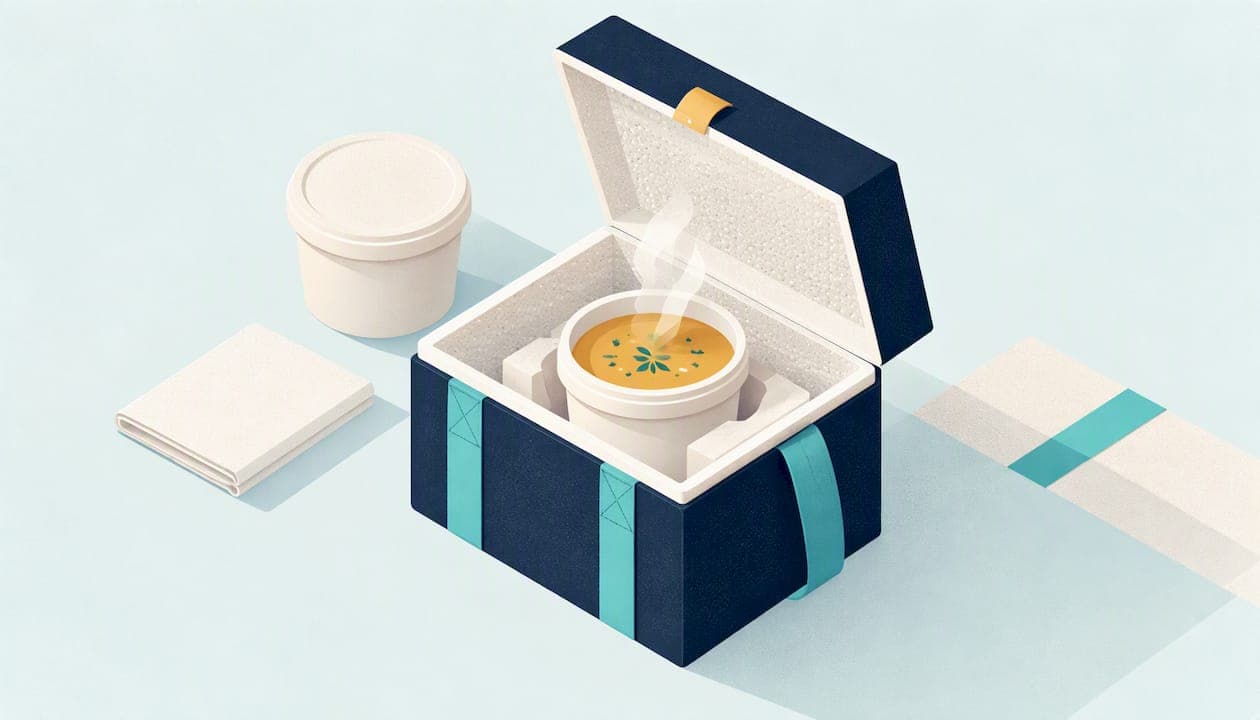
Good soup delivery packaging is a bowl-and-lid system, not just a pot. The container, the rim, the lid fit, the way it is bagged and the paperwork behind the material all decide whether a customer opens a hot, tidy lunch or a soggy bag. This guide is for UK restaurants, cafés and dessert-and-soup counters that want to get it right and have the packaging look like their own brand.
TL;DR
- Judge soup packaging as a system: container wall, rim shape, lid seal, venting and outer bag all matter together.
- Ask your supplier for written food-contact compliance covering your soup, its temperature and contact time. "Food safe" and "leak-proof" on a product page are not evidence.
- "Compostable" is not automatically the better UK choice. Check the disposal route and the evidence behind any claim.
- Test with your real recipe, filled hot, carried on a real delivery journey, before you order in bulk.
- Branding soup packaging is practical: a printed sleeve, bag or lid sticker makes plain containers look like yours without changing the tested container.
Table of Contents
- Why soup is the hardest item on a delivery menu
- Choosing the container: what actually matters
- Check the paperwork, not just the product page
- The sustainability question, answered honestly
- A note on VAT and hot soup
- How to pack soup for delivery, step by step
- Run a proper test before you order in bulk
- Making soup packaging look like yours
- Our perspective: treat the soup pot as part of your menu
- Build a soup range with Niche Pack
- Mistakes to avoid
- FAQ
- Sources
Why soup is the hardest item on a delivery menu
A burger can sit in a box for twenty minutes and survive. Soup cannot. It is hot, liquid and often oily or acidic, and it moves around in a bag on the back of a bike or in a car footwell. Three things go wrong most often:
- Leaks at the lid. The lid pops or the seal is not tight against the rim, usually after a bump or a stack.
- Pressure and steam. Hot soup sealed tight builds steam. Without a sensible lid design, it finds the weakest point.
- Wall failure. A lining that is not suited to hot, oily or acidic food can soften, seep or taste of the container.
Every decision below is about preventing one of those three.
Choosing the container: what actually matters
Rim and lid fit come first
When people search for leak-proof soup containers, they usually look at the bowl. Look at the rim first. A rolled or reinforced rim gives the lid something firm to grip. A thin, deformed or oval-ish rim will never seal, whatever the lid says. When you test samples, press the lid on, turn the container upside down over a sink for a few seconds, then squeeze gently on the sides. If it weeps, it will weep in transit.

Also check that the lid and container come from the same specification. Mixing a lid from one range with a container from another is a common cause of poor seals.
Material: paper, plastic or something else
The common options for soup are:
| Option | Strengths | Watch out for |
|---|---|---|
| Lined paper or board cup/bowl | Looks good, takes print well, feels natural | Lining must suit hot, oily and acidic soups; lid fit varies |
| Rigid plastic (such as polypropylene) tub | Strong rim, firm lid seal, often microwaveable | Perception with eco-minded customers; disposal route |
| Plant-based lined bowls | Strong sustainability story | Claims need evidence; see the section on sustainability below |
| Stand-up pouches | Compact, good for cold or chilled soups | Not the usual choice for a hot, ready-to-eat counter offer |
There is no single best answer. A cream soup with a layer of oil on top asks more of a lining than a clear broth. A hot curry-style soup asks more than a chilled gazpacho. The right container is the one tested against your menu.
Sizing and headspace
Fill soup to leave headspace under the lid. Overfilling is behind a surprising number of "leaky" complaints, because the lid sits on liquid rather than air. Most UK operators work with a small range of sizes, typically a small portion for sides or tasters, a standard lunch portion and a larger meal portion. Pick sizes that you can fill with a consistent ladle count, so portions are the same every time and headspace is predictable.
A practical routine: choose the ladle that fills the container to just below the rim, mark that on your prep sheet, and do not let a busy shift change it.

Venting
Some lids include a small vent to release steam. This reduces pressure, but it is also a possible leak point if the container tips. If you deliver by bike or scooter, test vented lids on their side. If a lid is unvented, let the soup settle for a moment before closing so the first burst of steam escapes.
Check the paperwork, not just the product page
This is the step independent restaurants skip, and it is the one that causes problems after launch.
UK guidance for food businesses is clear that packaging must be suitable for food use. London Borough of Bromley's food-contact materials guidance tells businesses to look for the food-contact symbol or written compliance documentation and not to assume that a container fine for cold food is fine for hot, acidic or oily food. It also points out that suppliers should provide documentation covering food type, contact time and temperature.
In practice, before you approve a custom soup container, ask your supplier for:
- A Declaration of Compliance for the container, lid and any lining or print in contact with food.
- Confirmation of the food types, contact time and temperature it covers. Your soup is hot and may sit for 30 to 45 minutes in delivery, so that has to be within scope.
- Details of any print or coating that could touch food, so you know whether branding sits on the outside only.
A general assurance from a supplier is not the same as evidence tied to your intended use. Asking early costs nothing. Finding out after a launch that a lining did not suit your menu costs a reprint and a reputation.
The sustainability question, answered honestly
Many owners assume the compostable bowl is the greenest choice. It is more complicated in the UK. The Food and Drink Federation notes that UK extended producer responsibility (EPR) rules do not currently mandate compostability and treat compostable packaging as non-recyclable for EPR purposes, which can affect the fees a business pays. Compostable and recyclable are not interchangeable terms.
So compare the whole system:
- Is there a collection route? Compostable packaging is only useful if your customers or waste contractor can actually compost it. Food-soiled paper bowls often cannot go in standard recycling either.
- Is the claim verified? Ask for evidence behind any "compostable" or "recyclable" statement, and do not print the claim on your pack unless you can support it.
- Can you reduce material overall? A right-sized container, and one outer bag instead of two, cuts waste before any material debate starts.
- Is reuse an option? For regulars who collect, a returnable or reusable option may beat any single-use material.
If you want to stay careful with claims, describe what you know: the material, where it is made, how you want customers to dispose of it. Customers respond better to specifics than to a leaf icon.
A note on VAT and hot soup
Hot soup is a hot takeaway food for VAT purposes, and packaging can come into the test. HMRC's VAT food manual lists cups of soup among its examples of hot takeaway food, and it distinguishes ordinary paper bags from packaging specially designed for hot food or that retains heat. Do not infer your VAT treatment from the container alone. If you sell soup in several ways (eat in, collect, delivery, chilled), ask your accountant or HMRC about your exact arrangement before you set prices.
How to pack soup for delivery, step by step
- Fill hot, not boiling, and to the mark. Leave headspace under the lid.
- Wipe the rim. A drip of soup on the rim stops the lid sealing. A clean cloth takes seconds.
- Seat the lid fully. Press around the whole rim until it clicks or sits flat. Do it once, with confidence.
- Add a tamper seal or label if you deliver. A sticker across the lid shows the pack has not been opened and also carries your logo.
- Keep it upright. Use a bag with a flat base or a carrier that holds the container so it cannot tip.
- Separate the extras. Bread, toppings and cutlery go in their own compartment or paper bag, so steam does not soften them.
- Bag it once, tightly. Do not stack heavy items on top of soup.
- Brief the rider. A short card or instruction on your bag, "keep upright", costs nothing and helps.
Run a proper test before you order in bulk
Samples are cheap. Failed deliveries are not. A simple test plan:
- Fill three samples with your real soup at serving temperature, including your thickest and your oiliest recipe.
- Seal, bag and carry them for your longest typical delivery distance, on the vehicle your riders use.
- Tip one on its side for a minute and lift one by its sides.
- Open each at the end. Check for leaks, softening, taste transfer, lid distortion and how hot the soup still is.
- Photograph the opened pack as your customer would see it.
If you work across several soups, test the worst case, not the average.
Making soup packaging look like yours
Soup is one of the easiest menu items to under-brand. Most operators default to a plain white or kraft pot, and every other soup looks the same in the bag. Branding does not require reinventing the container. Options that work well in practice:
- Printed paper sleeves that wrap the container, covering the body while leaving the lid fit untouched.
- Branded bags that carry the logo into the customer's office or home.
- Lid stickers or tamper seals with your name and the soup of the day.
- Matching add-ons such as napkins, bread bags and cutlery wraps, so the whole order looks consistent.
Keeping the print on the outside means your food-contact paperwork stays straightforward, though you should still confirm this with your supplier for any given product.
Our perspective: treat the soup pot as part of your menu
We work with independent hospitality brands whose food is distinctive but whose takeaway packaging is not. The most common story is a restaurant with a strong identity in the room and a generic, unbranded container at the door. For soup, that gap is easy to close, and it is also where practical decisions matter most.
Our view is simple. Start with function, then build the brand around it. Decide how the soup travels, test the container and lid with your recipe, get the compliance documents, and only then design the sleeve, bag and add-ons around that tested core. A beautiful print on a lid that pops open does more harm than a plain pot ever did.
We also encourage owners to be wary of sustainability shortcuts. A choice that sounds green but has no collection route behind it will not stand up to a customer's question. We would rather help you choose a material you can explain honestly, with UK-based production for quicker turnaround and technical print audits so the finished pack looks as intended.
If you are not technical, that is fine. Tell us what you sell, how it is delivered and how many covers or orders you expect, and we will help you work out the range from there.
— Melanie
Build a soup range with Niche Pack
Niche Pack makes custom branded food packaging for independent restaurants, cafés, fast food brands and dessert businesses: cups, bowls, boxes, bags, paper sleeves and add-ons, with consultation from design through to delivery. You can browse the shop for cups, bowls and bags, or use the range builder to put together a coordinated set for your menu. If you would rather talk it through first, start from our main page and tell us what you serve. We have not published prices, so quotes come after a conversation about your volumes and materials.
Mistakes to avoid
- Buying on photographs. A lid that looks snug in a photo can fail on a bike. Always test.
- One size for every soup. A thick stew and a thin broth behave differently.
- Ignoring the outer bag. A good pot in a flimsy bag still arrives tipped.
- Making environmental claims you cannot support. Keep to what you can document.
- Skipping the paperwork. Documentation is the cheapest insurance you can buy.
- Branding first, testing second. Order print only on a container you have already proven.
FAQ
How do you pack soup for delivery?
Fill the container to just below the rim, wipe the rim clean and press the lid on fully around its edge. Seal it with a label or tamper strip, keep it upright in a bag with a flat base, and put bread and toppings in a separate bag. Test your longest delivery route before you launch.
What is the best container to deliver soup in?
There is no single answer, because it depends on your recipe and delivery distance. Look for a firm rim, a lid from the same range, a lining suited to hot, oily or acidic food, and written compliance documentation. Test your own soup in samples before ordering in bulk.
Are leak-proof soup containers really leak-proof?
Treat "leak-proof" as a claim to check, not a guarantee. Fill samples with your hot soup, turn them upside down, tip them on their side and carry them on a real delivery. Ask the supplier for compliance evidence that covers your food type, contact time and temperature, as local authority guidance recommends.
Is compostable soup packaging the better choice in the UK?
Not automatically. UK EPR rules, as summarised by the Food and Drink Federation, treat compostable packaging as non-recyclable for EPR purposes, and a compostable pack only helps if there is a route to compost it. Compare the material, the evidence and the disposal route before you decide.
Can I put my branding on soup containers?
Yes. Many restaurants brand the outside with printed sleeves, bags and lid stickers, and some print the container itself. Confirm with your supplier that any print or coating that could touch food is covered by the compliance documents.
Sources
- Food contact materials, London Borough of Bromley
- VFOOD4220: hot and cold take-away food, HMRC internal manual, GOV.UK
- Food and Drink Federation: packaging guidance