
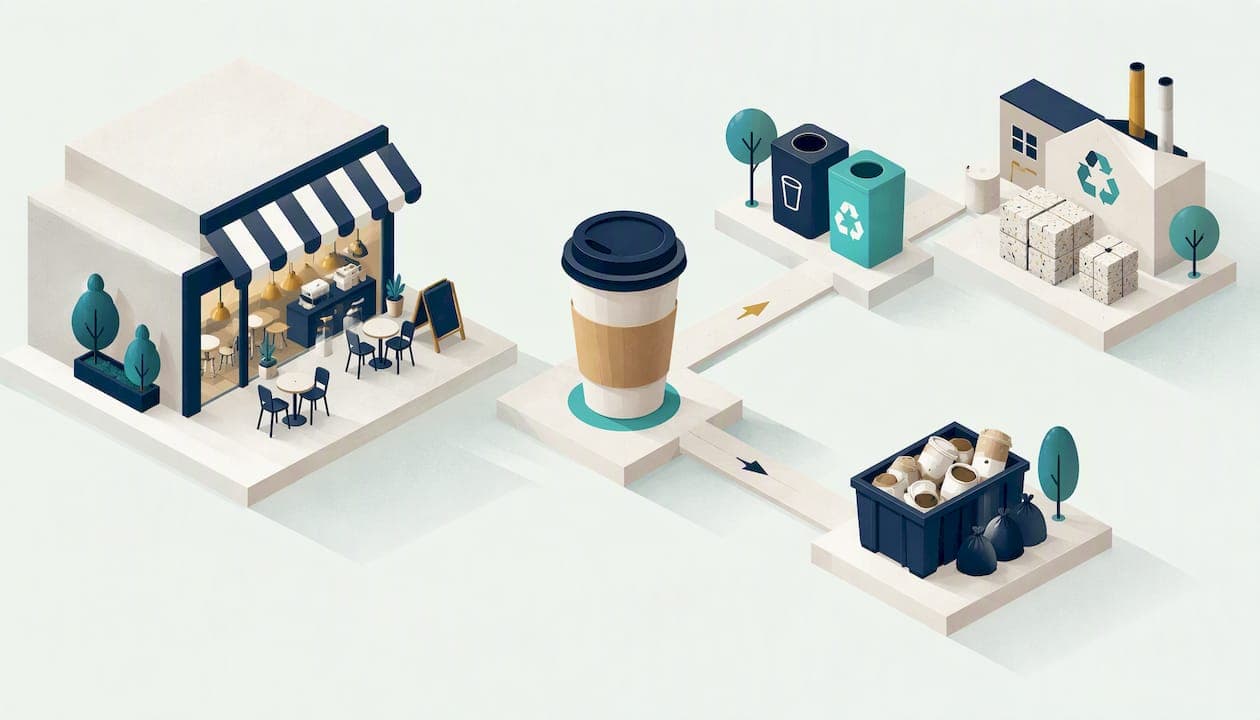
Most disposable coffee cups in the UK cannot go in your household recycling bin. The thin plastic lining that stops a flat white leaking through the wall also stops the cup behaving like ordinary paper. Recycling a cup properly means a named cup collection, a take-back point, or a council that explicitly accepts them. If you run a café, the cup you choose and the way you tell customers to dispose of it are part of the same decision.
This guide covers both sides: what to do with a used cup today, and what an independent café should ask before specifying the next print run.
TL;DR
- Lined paper cups are not accepted by most ordinary paper and card recycling. Rules are set by each council, so check your postcode before using a household bin.
- Empty the cup, then separate the lid and sleeve. This applies to home, office and café collections alike.
- "Compostable" does not mean "recyclable". Compostable cups need the right commercial composting route, and many customers will not have access to one.
- Cafés should tie any "recyclable" claim to a real UK collection route and ask suppliers for material evidence.
- Reusable cups cut the problem at source, and cup design can make the right disposal route obvious.
Table of Contents
- Why a paper cup is not just paper
- Can you recycle coffee cups at home in the UK?
- How specialist cup recycling works
- Compostable cups: what they are and are not
- What this means for a café or restaurant
- Perspective: design the cup around its end of life
- Reusables, discounts and the bigger picture
- Related household questions, briefly
- Choosing custom cups with recycling in mind
- FAQ
- Sources
Why a paper cup is not just paper
A takeaway cup looks like card, so people treat it like card. The lining is the problem. As Costa explains in its cup information, the thin plastic layer keeps liquid in but makes the fibre harder to separate in standard paper streams.
The lining solves a performance problem (heat and leak resistance) and creates a sorting and pulping problem. A cup that works brilliantly at 90°C in a commuter's hand may be rejected at the sorting plant.
The scale of the gap is worth knowing, with a caveat on dates. BBC reporting from 2018, as cited by Costa, found that more than 99.75% of disposable cups were not being recycled at that point. That is a historical baseline, not today's rate. Defra's own consultation material estimated that roughly 0.25% of paper cups were recycled at the time of its analysis. Collection schemes have grown since: Costa says more than 200 million cups have been recycled through the National Cup Recycling Scheme since 2018. That figure belongs to one scheme, not the whole UK.

Can you recycle coffee cups at home in the UK?
Sometimes, but never by default. GOV.UK explains that household collections are set by your local authority, and its guidance covers England and Wales. Scotland and Northern Ireland run their own arrangements. So there is no single national answer.
Three councils show how much the answers differ:
| Council | What it says about takeaway cups |
|---|---|
| West Sussex County Council | Some takeaway cups can be recycled at home. Paper and plastic cups and lids must be empty, clean and dry. Polystyrene and Styrofoam cups go in general waste. |
| Stirling Council | Lid in the blue bin, cup in the grey bin. |
| Councils with no cup stream | Cups are treated as residual waste, or must go to a dedicated collection point. |
The same cup is therefore recyclable in one postcode and not in the next. For customers, the only safe instruction is to check the local council. That is also why a café's national messaging should avoid blanket "pop it in the recycling" wording.
What to do with an old coffee cup: the safe sequence
- Empty it. Pour away leftover drink. Liquid contaminates other recycling.
- Separate the parts. Take off the lid and sleeve. Lids are often a different plastic from the cup, and the sleeve may be a different grade of paper.
- Check your council. Use the postcode checker on your council's site, as GOV.UK directs.
- Use a named cup route if your council does not accept them. That might be a retailer take-back bin or a dedicated cup collection.
- Keep lined cups out of ordinary paper and card unless your council explicitly accepts them. The Recycling Centre's guidance takes the same line.
If you are unsure, general waste is better than a contaminated recycling bin. One wrong item can downgrade a whole load.
How specialist cup recycling works
Dedicated cup recycling is a different process from kerbside paper recycling. Veolia's UK service description sets out the steps. Users drain the remaining drink and separate lid, sleeve and cup. Cups are boxed and collected, then sorted and pulped. Pulping separates the paper fibre from the plastic lining so each can be reused. Anything that cannot be recycled may be used to generate energy.
For a business, the operational detail matters more than the theory:
- Drain every cup before it goes in the container.
- Remove lids and sleeves at the point of disposal, not afterwards.
- Stack cups and use the specified lined box or collection container.
- Book collections according to the provider's instructions.
Separating the parts reduces rogue items and improves the quality of material entering the pulper. A clearly labelled return station is part of the recycling system. It is not a branding extra.
Compostable cups: what they are and are not
People searching for compostable or plastic-free cups usually want to avoid the lining problem altogether. It is a reasonable instinct, but it comes with conditions.
Compostable cups are not automatically recyclable. They need the appropriate commercial composting route, and local instructions still apply. Putting a compostable cup in a paper recycling bin can contaminate it just as a conventional lined cup does. Putting one in a home compost heap may not break it down at all.

Before you switch, ask what actually happens to the cup in your area. If your customers cannot reach a composting route, the claim on the cup is not worth much. Being honest about this protects your reputation as well as the planet.
What this means for a café or restaurant
The policy direction is clear, even where the detail is still moving. Defra's consultation on disposable cups takeback proposed separate collection and recycling of filled disposable paper cups, including cups regardless of brand or place of purchase. It also pointed to a recycling target for fibre-based composite packaging from 2026. That is policy context, not proof that every café already has a universal takeback duty. Check current requirements for your business before you rely on any of it.
What you can do now is treat three things as one project:
- The cup specification. What it is made of, and how it behaves at end of life.
- The customer message. What you tell people to do with it.
- The collection route. Where the cup physically goes.
Questions to put to any cup supplier
A "recyclable" claim should point to a defined UK collection route and a material specification. Ask for:
- Material composition, including the lining type.
- Certification that supports the claim.
- The accepted collection route, and where it operates.
- Lid compatibility, since lids often follow a different route.
- Evidence that the route exists in the locations you serve, not just somewhere in the UK.
If a supplier cannot answer these, the claim is marketing, not specification. Our guide to avoiding recycling failures when choosing coated or uncoated paper goes deeper on how coatings affect what happens next.
Set up a return point that works
If you offer a cup return point, make it simple to use:
- Place it near the door, not behind the counter.
- Use three clear slots or bins: liquids, lids and sleeves, and cups.
- Say on the signage which cups it accepts. Customers will bring other cafés' cups too.
- Train staff to check bins for contamination at close.
- Keep a record of your collection schedule, so you can say honestly where cups go.
If you are redesigning the counter experience as well, it is a good moment to look at the beans, grind and menu together. A café refreshing its coffee offer might look at freshly roasted espresso beans from a German roaster as part of the same review. The cup and the coffee inside it are one product to the customer.
Perspective: design the cup around its end of life
We work with independent cafés, restaurants and dessert shops on custom packaging, and the same pattern appears again and again. Owners start with the look of the cup: colour, logo, finish. They come to the end-of-life question late, often when a customer asks it at the counter.
Our view is that it should come first. Decide which route the cup will take, then design for it. A few principles guide our consultations:
- Print with the material in mind. Heavy coverage and extra non-paper elements can complicate recycling. Our post on keeping non-paper content under 15% on coffee cups explains how we approach it.
- Offer sustainable material options, then be precise about them. A material is only as sustainable as the route that handles it. We would rather you make a modest, accurate claim than a large, vague one.
- Use a technical print audit before you commit. Catching a problem on artwork is far cheaper than catching it on a pallet.
- Make the disposal instruction part of the design. A short line telling people to empty the cup and separate the lid costs nothing in ink and changes behaviour.
We are UK-based, with accessible minimum order quantities, so a small café can test a considered design without committing to a huge run. Reusable cups are also worth a place in the range. They are the only option that reduces the number of cups entering the waste stream at all.
— Melanie
Reusables, discounts and the bigger picture
Recycling is the last resort in the waste hierarchy, not the first. Defra's consultation states that the government aims to increase the use of reusable cups, reduce the use of difficult-to-recycle single-use cups and raise recycling of those that remain.
For an independent café, that suggests a mixed approach:
- Offer a reusable cup and a discount for bringing one.
- Keep disposable cups for the customers who need them, and choose them with a real route in mind.
- Tell customers plainly what to do with the cup.
None of this needs a large budget. It needs a decision, a bit of signage and a supplier who can answer material questions.
Related household questions, briefly
People who search for cup recycling often have neighbouring questions, so here are quick answers with the caveat that councils differ.
Bottle caps. Council guidance such as South Derbyshire's commonly allows metal jar and bottle lids in metal recycling. Many councils suggest leaving plastic bottle caps on empty plastic bottles, but rules vary.
Coffee pods. Do not put them in the normal recycling bin, as they can contaminate the load. Use a manufacturer or Podback route, a participating supermarket or a household recycling centre. Richmond's guidance asks for aluminium and plastic pods to be kept separate. Availability depends on your postcode and pod type, so check before you travel. Some councils have withdrawn their pod bins, as Wychavon explains.
Coffee grounds. South Derbyshire directs them to the food waste bin, per its A to Z.
Choosing custom cups with recycling in mind
If you are ready to specify new cups, this is the order we suggest:
- Find your route. Check which cup collections or take-back points serve your area.
- Pick the construction. Lined paper, compostable or reusable, each matched to the route you found.
- Check lids and sleeves. They must fit the same route, or be easy to separate.
- Audit the artwork. Confirm print coverage and non-paper content.
- Write the customer message. One clear line on the cup, one on the sign.
- Review after a trial. Look at contamination in your return point and adjust.
If you need help with step 2 or 4, we can support you. Our custom printed cups and tubs come with expert consultation, technical print audits and a selection of sustainable material options. If you want cups, lids, bags and sleeves to work as one range, the range builder lets you plan them together, and you can browse the full shop. Tell us what you sell, and we will help you build packaging with personality that also stands up to scrutiny.
FAQ
Are coffee cups recyclable in the UK?
Some are, but only through the right route. Most disposable cups have a plastic lining, so they do not belong in ordinary paper and card recycling. A few councils accept clean, empty cups, and dedicated cup collections and take-back points exist. Check your council's postcode checker first.
Can I put a compostable cup in the recycling bin?
Usually not. Compostable cups need an appropriate commercial composting route, and they can contaminate paper recycling. Follow the instructions on the cup and your council's guidance. If neither gives a clear route, general waste is the safer choice.
What should I do with the lid and sleeve?
Remove them before disposal. Specialist cup recycling starts with separating lid, sleeve and cup, as Veolia's process describes. Lids and sleeves may follow different routes, such as plastic recycling for the lid, so check your council's rules for each part.
How can a café offer cup recycling to customers?
Set up a labelled return point and arrange a collection with a cup recycling provider. Drain cups, separate parts, use the specified container and book collections as the provider instructs. Be honest on signage about what you accept and where the cups go.
Are plastic-free coffee cups the same as recyclable ones?
No. A plastic-free cup may be designed for composting rather than recycling, and it still needs the right disposal route. Ask your supplier for material composition, certification and the accepted collection route before you make a claim to customers.
Sources
- Recycling collections, GOV.UK
- Coffee Cup Recycling Service, Veolia UK
- Cups, Costa Coffee sustainability
- Coffee cups, The Recycling Centre
- Takeaway coffee cups, West Sussex County Council
- Waste and Recycling Directory, Stirling Council
- Producer obligations: disposable cups takeback, Defra
- A to Z of waste, South Derbyshire District Council
- Where to recycle your items, London Borough of Richmond upon Thames
- Recycling, Wychavon District Council