
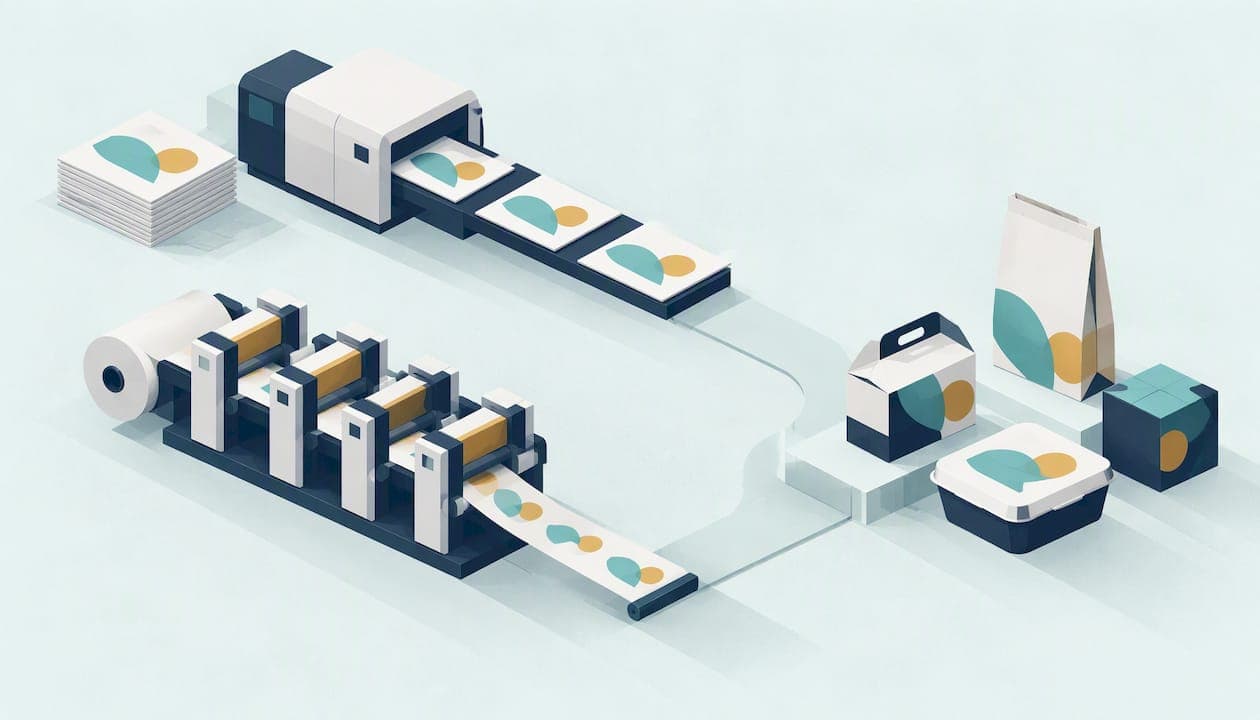
Digital printing suits short runs, several designs and artwork that changes often. Flexo suits large runs of a stable design, where plate costs are spread over thousands of units. For most independent restaurants, cafés and dessert shops placing a first branded order, the deciding factors are quantity, the number of different designs and how settled your artwork is. Print quality matters less than it used to.
This guide explains how each process works and where the cost curve turns. It also covers what each does to materials and finish, how offset fits in, and how to decide before you brief a supplier.
TL;DR
- Digital has no plates, so it works well for small runs, several designs or a menu that changes. The cost per unit stays broadly flat as volume grows.
- Flexo needs plates and setup, but the unit cost falls as the run grows. It suits one stable design in high volume.
- Choose by economics: quantity, number of designs and artwork stability. Habit is the wrong guide.
- Modern flexo quality is much better than its old reputation, so do not rule it out on looks alone.
- Not sure which fits? Send us your menu, volumes and artwork stage and we will help you work it out.
Table of Contents
- How the two processes differ
- Where the cost curve turns
- Digital vs flexo at a glance
- Does the print quality differ?
- Materials and surfaces
- Sustainability: the process is only part of it
- Choosing: a checklist for hospitality owners
- Our perspective
- Work out the right route for your range
- FAQ
- Sources
How the two processes differ
Digital printing
In digital printing, the artwork goes from a computer file straight to the press, which applies ink or toner without a physical printing plate. Strouse, which has helped launch over 1,000 printed products, describes digital methods as primarily inkjet or toner-based.
No plate means no plate cost. You can change a file between runs, or print different designs in one batch, without paying to tool each one again. That is why digital is the usual answer for small volumes and multiple designs.
Flexographic printing
Flexo prints from flexible photopolymer plates on a rotary press. Each colour in the design needs its own plate, so the first run carries setup work: preparing artwork, making plates, mounting them and matching colours on press.
Once that is done, flexo runs fast. Presses that run quickly make it an efficient way to produce high volumes at good quality. Because setup is paid once, each additional unit lowers the average cost, in contrast to digital, where the 10,000th unit costs about the same as the first.
And offset?
Many people searching this topic also compare flexo with offset. Offset lithography is the traditional sheet-fed process for printed paper and board, and it is widely available. It also uses plates, so it shares the same logic as flexo: setup cost up front, a lower unit cost at volume. It is most relevant for flat printed board, such as folding cartons and sleeves. Flexo is more common where you are printing on rolls of paper or film. For a hospitality brand the practical question is usually the same: how many units, and how many designs?
Where the cost curve turns
The most useful framing comes from the market analysts. Dr Sean Smyth at Smithers argues that the choice should follow quantity, SKU count and artwork stability rather than habit. Choose wrongly and you either pay for tooling you never use up, or overpay per unit for years.
Here is how that looks in practice. The figures below are an illustration of the logic, not prices.
Scenario A: a café with one logo and a seasonal range. You want a cup in your brand colours, plus a winter variant and a summer variant. With flexo you would pay for plates for each design, and each variant would need a volume large enough to justify them. With digital you pay no plate cost, so three smaller runs are viable.
Scenario B: a fast food group with one fixed bag design. The artwork has not changed in two years and you order every month. Plates are made once and reused, so flexo's falling unit cost wins.
Scenario C: a dessert shop launching with five box sizes. Five formats, uncertain demand, and artwork you may refine after customer feedback. Digital keeps the risk low. You can move to a plate-based process for the best sellers once their volumes are proven.

The pattern is simple. Uncertainty favours digital. Stability and scale favour flexo.
A quick way to estimate your break-even
- Ask for the one-off setup cost for each design in a flexo quote (plates, proofing, make-ready).
- Ask for the unit price at three quantities in both processes.
- Work out the difference in unit price between digital and flexo at each quantity.
- Divide the flexo setup cost by that difference. The result is roughly the number of units at which flexo starts to cost less.
- Compare it with the volume you will really use before the design changes. Be honest about that number.
If the break-even is far above what you will use before a rebrand, a menu change or a new seasonal design, digital is the safer choice.
Digital vs flexo at a glance
| Factor | Digital | Flexo |
|---|---|---|
| Tooling | No plates | Plates for each design and colour |
| Best volume | Small to medium runs | Medium to large runs |
| Several designs in one order | Straightforward | Each design adds setup cost |
| Unit cost as volume grows | Broadly flat | Falls steadily |
| Artwork changes | Easy between runs | Usually means new plates |
| Speed on press | Slower | Faster |
| Suited to | Launches, seasonal lines, tests | Established, stable designs |
Does the print quality differ?
This is where outdated advice lingers. Flexo once had a reputation for a "halo": ink squeezed to the edges of the image. According to a Cal Poly paper on high-volume printing processes, advances in anilox rolls, computer-to-plate systems and energy-curable inks have largely addressed it. It reports that modern high-end presses using a "kiss-print" approach make flexo hard to tell apart from other high-quality processes for the untrained eye.
Flexo still plays to its strengths with solid colours, bold logos and line work. Digital handles photographic images, gradients and fine detail very comfortably, and inkjet systems keep improving in speed and ink choice, as ink manufacturers themselves note.
Colour consistency is the other issue. If your brand colour is a specific teal or terracotta, ask how it will be matched and checked across runs. Industry bodies work on this: Fogra's ProcessStandard Flexo aims to give predictable colour accuracy and process stability in flexographic printing. You do not need to master the standard. You do need a supplier who checks colour and registration before the full run, not after.
Materials and surfaces
The substrate can narrow your choice before cost does. Flexo is versatile on non-porous and textured materials such as plastic films and corrugated board, and it can lay down opaque white under process colours when the stock is clear or dark. Digital has more limits depending on the ink system and the surface, so check the specific material you want.
For hospitality, think about what each item has to survive:
- Cups and tubs: curved, sometimes coated surfaces, with condensation and heat. Ask how the print holds up on the exact cup you will use.
- Bags: handling, rubbing and grease. Solid colour areas on kraft need particular care. Our guide to paper bag branding for UK retail and hospitality covers how to avoid reprints.
- Boxes: folds, creases and glued areas, where heavy ink coverage can crack. See our range of custom printed food boxes.
- Sleeves and paper: light, flat items where fine detail and tight registration show up.
The stock you pick matters as much as the process. An uncoated kraft board takes colour differently from a white-lined one. Your colours will look more muted on kraft, which can suit an earthy brand, but you should know it before you approve artwork.
Sustainability: the process is only part of it
Eco-conscious customers look at materials, recyclability and how the pack is disposed of, not at the print process. Neither digital nor flexo is automatically greener. What counts is the choice of paper or board, the inks and coatings, how much ink coverage the design needs, and whether waste is kept down.
That last point favours matching the process to your volumes. Overordering a plate-based run to hit a lower unit price can leave you with boxes you throw away after a rebrand. Printing what you will use is a sustainability decision as well as a financial one.
If you want to tell customers about the sustainable side of your pack, that story needs telling well. Specialist marketing support for food and drink brands can help turn a packaging change into a campaign people notice.
Choosing: a checklist for hospitality owners
Work through these in order.
- Count your designs. One cup, one bag, one box, or a dozen combinations? More designs push toward digital.
- Estimate real annual volume per design. Use sales data, not hopes. Include seasonal peaks.
- Judge how settled your branding is. Rebrand or menu change within 12 months? Stay flexible.
- Check your material. Confirm the process can print on it, and ask for a sample.
- Decide the quality bar. Solid logo on kraft is different from a full-colour illustration.
- Plan storage and cash. A big flexo run saves unit cost but ties up cash and shelf space.
- Ask for a technical print check before artwork is approved: bleed, fold lines, colour values, minimum line weights.
Common mistakes
- Choosing flexo for a design you will change in six months.
- Choosing digital for a stable, high-volume item and paying more per unit for years.
- Approving artwork on screen only, without checking how colours behave on the real stock.
- Making every item a different design when a cohesive system would cost less and look stronger.
That last point deserves attention. A range that shares a visual system, such as one logo lockup, a palette and a pattern across cup, bag and box, often needs fewer unique artworks than you would expect. Fewer artworks make the economics easier whichever process you use. Our food packaging range builder is designed to help you plan that kind of range.
Our perspective
Most owners who come to us do not ask which print process we use. They tell us they have a good brand and a takeaway bag that looks like everyone else's. The process question comes second, and it should: the first job is to decide what the packaging has to do.
We see the same pattern repeatedly. Owners worry about unit price before they have settled the range. A smaller, cohesive set of packaging pieces, printed in quantities you can actually use, almost always beats a sprawling set of designs chosen for the cheapest headline price.

Our approach is built around people who are not packaging specialists. We offer expert consultation, UK-based production for agility, accessible minimum order quantities and technical print audits so problems are caught before anything is printed. We do not think a restaurant owner should need to understand anilox rolls to get a good result. Our job is to understand them for you, then explain the trade-offs in plain terms: how many designs, how many units, how settled the artwork is.
We would also rather tell you to wait than sell you a run you will regret. If your brand is still changing, order small and learn. If a design has proved itself, that is the time to scale it.
— Melanie
Work out the right route for your range
If you run an independent restaurant, café, dessert shop or fast food business and want branded cups, bowls, boxes, bags or sleeves, we will help you plan the range and choose a sensible route to production. You can explore our shop for product types, or visit our homepage to see how packaging development and launch, range redevelopment and strategic production work. Tell us what you sell and roughly how much, and we will take it from there.
FAQ
Is digital printing cheaper than flexo?
It depends on volume. Digital avoids plate and setup costs, so it is usually cheaper for small runs and multiple designs. Flexo's unit cost falls as the run grows, so it tends to be cheaper at higher volumes of a single design. The break-even point depends on the item, the material and the number of colours.
Is flexo print quality worse than digital?
Not any more, in most cases. The old halo effect has been largely addressed by newer plates, anilox rolls and inks, according to research from Cal Poly. Digital still has the edge for photographic images and very fine detail, while flexo is strong on solid colour and bold graphics.
Can I start with digital and switch to flexo later?
Yes, and it is often sensible. Start with a smaller digital run to test the design and demand. Once a design is stable and selling steadily, ask for a plate-based quote for that item. Bear in mind that colours may shift slightly between processes, so ask for a proof against your existing packaging.
Is digital printing the same as laser printing?
Not exactly. Laser printing is one toner-based digital technology. Digital printing for packaging also includes inkjet systems, which are common in production. What they share is that the image is sent from a file with no printing plate.
Sources
- Digital vs Flexo Printing: A Comparison, Strouse
- The Future of Package Printing to 2029, Smithers
- Identifying High-Volume Printing Processes, Cal Poly Digital Commons
- Comparing Flexographic vs. Digital Printing Systems, Kao Collins
- Fogra ProcessStandard Flexo